
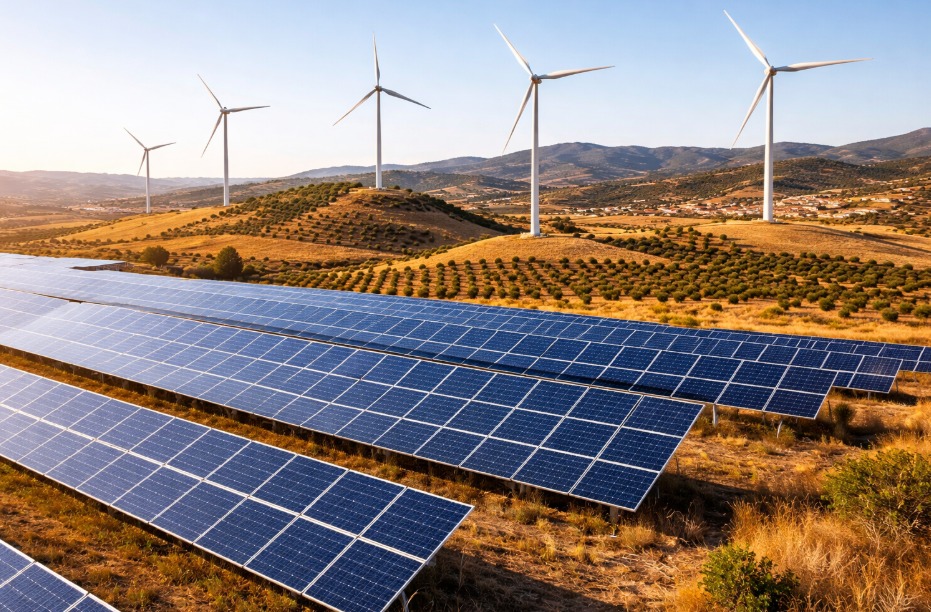
Investments in Solar and Wind Put Spain in a Strong Position Amid Global Energy Uncertainty
As global energy markets face renewed volatility, Spain is emerging as one of the best-positioned countries in Europe to limit the impact of rising electricity costs. A report by the European news network Euronews highlights how the country’s rapid expansion of renewable energy—particularly solar and wind power—has significantly lowered energy prices and reduced dependence on fossil fuels.
The development comes at a time when escalating tensions and conflict involving Iran are threatening to disrupt global oil and gas supplies, raising concerns about higher energy bills for households worldwide.
Renewable Expansion Drives Lower Energy Costs
Over the past six years, Spain has made substantial investments in renewable energy infrastructure. Since 2019, the country has doubled its solar and wind capacity, adding roughly 40 gigawatts of new generation.
This rapid expansion has made Spain the European Union’s second-largest producer of renewable energy, behind only Germany. The shift has also helped shield Spanish electricity prices from the volatility of international gas markets.
For Canadian observers, the development offers a notable contrast to countries whose energy systems remain closely tied to fossil fuel imports. While Canada benefits from abundant hydroelectric resources in provinces such as Quebec and British Columbia, many regions still face price pressures tied to global fuel markets.
Spain’s approach demonstrates how large-scale renewable investment can stabilize domestic energy costs.
Reduced Dependence on Imported Gas
One of the most significant impacts of Spain’s renewable expansion has been a sharp decline in natural gas imports.
Between 2020 and 2024, Spain reduced its gas imports by approximately 26 billion cubic metres. According to Euronews, increased wind and solar generation also cut the role of fossil fuels in electricity production by as much as 75 percent.
The transformation is visible in the country’s power generation mix. In several months during 2025—including August—Spain was able to operate its electricity system without relying on coal-fired power plants.
A decade earlier, coal had accounted for roughly a quarter of the country’s electricity generation.
Energy Crisis Highlights Vulnerabilities in Fossil Fuel Dependence
The latest geopolitical tensions involving Iran have sparked fears of a new global energy crisis. The closure of the Strait of Hormuz and reductions in oil exports have raised the prospect of sharply higher energy prices worldwide.
On the first day of the crisis alone, natural gas prices surged by about 55 percent.
For countries heavily dependent on imported fossil fuels, the spike illustrates the vulnerability of energy systems tied to global commodity markets. Spain’s renewable capacity, however, appears to be cushioning the immediate impact.
According to Euronews, Spain entered 2026 with some of the lowest electricity prices in Europe and maintained those levels during the first week of March, even after attacks in the Middle East began.
A Major Shift for Spanish Households
The renewable transition has delivered a dramatic reversal for Spanish consumers.
In 2019, Spain had some of the highest electricity prices in Europe. Today, households benefit from some of the lowest costs on the continent, largely due to the reduced influence of gas prices on electricity generation.
Analysts say the Spanish example may encourage other countries to accelerate their own energy transitions.
Renewable technologies such as wind and solar involve high upfront construction costs but relatively low operating expenses, since they do not require continuous fuel purchases. This contrasts with fossil fuel plants, where electricity production remains vulnerable to price swings in oil, gas, and coal.
Renewables Could Gain Momentum Worldwide
Energy experts suggest the current geopolitical crisis may reinforce the case for renewable energy across Europe and beyond.
Stable production costs make renewables attractive during periods of market uncertainty. In addition, the transition creates opportunities for households to participate directly through rooftop solar systems, electric vehicles, and other clean-energy technologies.
For policymakers in countries including Canada, where debates over energy security and emissions reduction continue, Spain’s experience provides a practical example of how sustained investment can reshape an energy system within a relatively short time.
Conclusion
Spain’s rapid expansion of solar and wind power is proving to be more than an environmental policy—it is also a strategic economic buffer. As geopolitical tensions push global fuel prices higher, the country’s reduced dependence on fossil fuels is helping protect households from rising energy costs. The Spanish case highlights how renewable energy can strengthen energy security while stabilizing prices in an increasingly uncertain global market.

Jacinto Benavente es colaborador de Revista Metrónomo, donde escribe sobre actualidad, política, negocios, tecnología, deportes, entretenimiento y estilo de vida. Su trabajo se centra en ofrecer información clara, precisa y relevante para los lectores, con un enfoque en los acontecimientos que marcan la agenda diaria. A través de una cobertura equilibrada y accesible, busca ayudar a la audiencia a comprender mejor los temas de interés público y las tendencias que influyen en la sociedad.