
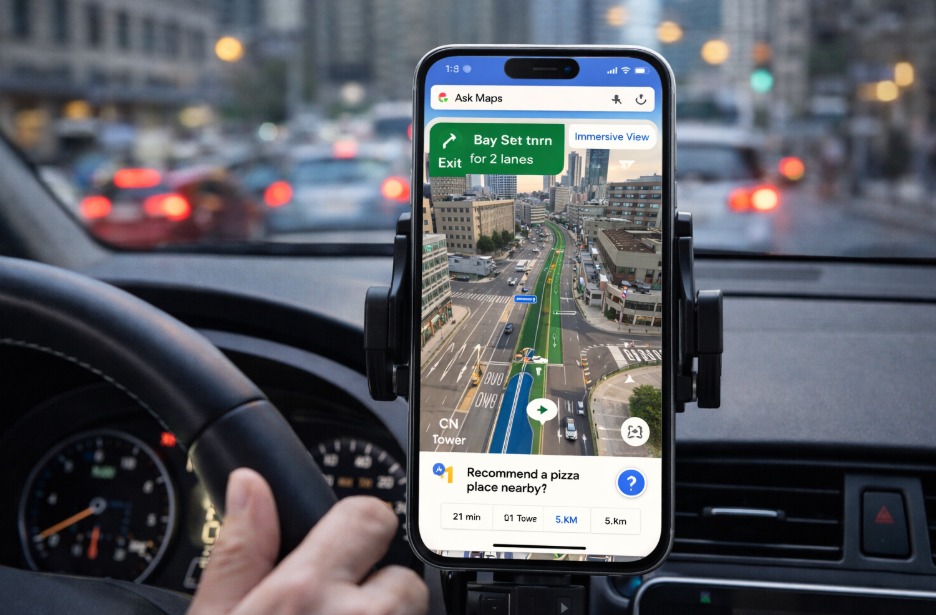
Google Maps is rolling out what the company describes as its most significant navigation update in more than a decade. Powered by Gemini artificial intelligence, the update introduces two major features — “Ask Maps” and Immersive Navigation — designed to make travel planning and real-time navigation more intuitive.
The new tools aim to reduce confusion for drivers and travellers who rely on GPS directions, a common frustration when navigation instructions are unclear or delayed. By combining AI, real-time data and enhanced visuals, Google says Maps will now function more like a digital travel assistant.
Gemini AI Comes to Google Maps
The update integrates Google’s Gemini AI models directly into the Maps platform, enabling users to interact with navigation in a more conversational and personalized way.
For many drivers, missing an exit or taking the wrong turn because of unclear directions is a familiar problem. Google says the new features aim to solve that by delivering clearer guidance and smarter recommendations during trips.
The two key additions — Ask Maps and Immersive Navigation — represent a major shift in how users interact with mapping services.
Ask Maps: A Conversational Travel Assistant
Natural voice interaction with navigation
The Ask Maps feature introduces a conversational interface that allows users to ask questions about locations and routes in natural language.
Similar to voice assistants found in modern vehicles, the feature allows travellers to interact with the map as if it were a co-pilot during the journey.
Using Gemini AI, Ask Maps analyzes a user’s preferences, previous searches and saved locations, along with real-time information and reviews available in Google Maps.
Users can ask questions such as:
- Where can I charge my phone without waiting in a long coffee shop line?
- Is there a public tennis court with lights where I can play tonight?
- Can you suggest a stop along my route?
- Is there a cozy restaurant with a table for four at 7 p.m.?
The system responds with clear directions, travel time estimates and personalized recommendations.
In some cases, users may also be able to book restaurant reservations, purchase tickets or share locations with friends directly through the platform.
Availability of Ask Maps
For now, Google says the feature is rolling out on Android and iOS devices in the United States and India.
A desktop version is expected to follow, though the company has not confirmed when the tool will become available in other markets such as Canada or Europe.
Immersive Navigation: A Smarter Way to Follow Your Route
Clearer guidance for complex intersections
The second major addition, Immersive Navigation, focuses on improving the driving experience itself.
Google describes it as a more intuitive guidance system designed to help users stay focused on the road while receiving clearer navigation instructions.
This feature is particularly useful in situations where drivers might hesitate — such as multi-lane intersections, highway exits or complex city streets.
Enhanced 3D maps and real-world details
The update introduces redesigned graphics and enhanced spatial awareness within the app.
Using Gemini AI, Google Maps now combines Street View imagery and aerial photography to create more detailed and realistic navigation visuals.
The map can highlight important road elements such as:
- Traffic lanes
- Pedestrian crossings
- Traffic lights
- Stop signs
- Turn lanes and merging points
These visual cues aim to make it easier for drivers to understand exactly where they need to turn or merge, reducing last-second lane changes and missed exits.
What This Could Mean for Canadian Users
While Google has not yet confirmed a Canadian launch date for the new tools, the update could eventually benefit drivers navigating complex urban environments such as Toronto, Vancouver or Montréal, where busy intersections and multi-lane highways often challenge GPS systems.
More accurate navigation could also improve travel in rural areas and long-distance road trips — a common experience for Canadians travelling between cities or across provinces.
The integration of AI-driven recommendations could also make Google Maps more useful for discovering local businesses, restaurants and attractions while travelling.
Conclusion
With the introduction of Ask Maps and Immersive Navigation, Google is pushing its mapping platform toward a more intelligent and interactive future. By combining conversational AI with enhanced visual navigation, the company hopes to make travel planning and driving directions clearer and more personalized. While the features are currently limited to a few markets, they signal a broader shift in how digital maps may guide users in the years ahead.

Jacinto Benavente es colaborador de Revista Metrónomo, donde escribe sobre actualidad, política, negocios, tecnología, deportes, entretenimiento y estilo de vida. Su trabajo se centra en ofrecer información clara, precisa y relevante para los lectores, con un enfoque en los acontecimientos que marcan la agenda diaria. A través de una cobertura equilibrada y accesible, busca ayudar a la audiencia a comprender mejor los temas de interés público y las tendencias que influyen en la sociedad.